As Google DeepMind notes, collecting robot data at this scale is prohibitively resource-intensive for any single lab. This is where egocentric data becomes especially valuable: it enables scalable, diverse data collection from human activity, making robot training more efficient and accessible.
A first-person video of someone picking up a cup may appear to contain a complete demonstration. It shows the hand approaching, grasping, and lifting the object, but it does not reveal key control signals such as contact force, joint torque, tactile feedback, or robot commands. Important finger movements may also be occluded, while the visible human trajectory may not be feasible for a humanoid with different joints, proportions, and balance constraints.
This is the central challenge in custom egocentric data collection for humanoid robot training: visually complete egocentric video data is not necessarily complete humanoid training data. The goal is to identify which human behaviors can provide useful robot supervision, which signals must be captured during collection, and which gaps still require robot-native data.

Pika Pro - Custom Egocentric & UMI Data Collection
Key Conclusions for Custom Egocentric Data Collection
-
Egocentric data collection amplifies robot data rather than replacing it
Human demonstrations provide scalable visual experience, task diversity, object interactions, and motion priors. However, they do not directly contain the target robot’s joint commands, proprioception, actuator dynamics, force feedback, or balance constraints.
Their primary value is to reduce the amount of robot-specific experience required. Human data provides scale and behavioral coverage, while robot-native data turns that knowledge into executable actions.
-
The training objective should determine the custom data collection system
There is no universally optimal egocentric capture setup. A dataset intended for visual pretraining may only require diverse RGB video and language, while dexterous manipulation may require wrist views, depth, finger tracking, object pose, and contact signals. Whole-body humanoid learning may additionally need full-body pose, foot contact, and environment geometry.
The collection system should therefore be designed backward from what the model must predict. Hardware selection, sensor placement, synchronization requirements, and annotation granularity should follow the training objective — not precede it.
-
Action observability — not video volume — should determine data quality
A demonstration can appear complete while omitting the variables required for training. RGB video may show that an object was lifted without revealing the finger configuration, contact force, or wrist stiffness responsible for the successful grasp.
More video is useful only when it preserves the supervision the target model needs. Collection teams should evaluate whether relevant actions, contacts, object states, and motion variables can be recovered reliably, rather than treating total recorded hours as the main quality metric.
-
Egocentric data annotation should represent physical interaction, not only action names
Labels such as “pick up cup” or “open drawer” are useful for activity recognition but insufficient for robot manipulation. Robot-oriented annotation should describe action phases, object-state transitions, hand or body motion, contact events, outcomes, failures, and uncertainty where relevant.
Some semantic labels can be added after recording. Physical signals such as force, accurate depth, synchronization, and motion hidden from every camera cannot. Collection and annotation must therefore be designed together.
-
Humanoid robot training requires alignment across observation, embodiment, and dynamics
Matching camera position and field of view can reduce visual domain shift, but it does not make a human trajectory directly executable by a robot. Human and robot bodies differ in joint structure, reach, hand geometry, actuator limits, balance, and safe behavior.
A practical training stack combines human egocentric data for scale and task knowledge, aligned human–robot demonstrations for cross-embodiment transfer, robot-native data for control, and simulation for feasibility and exploration. The objective is not to copy human motion exactly, but to preserve its task-relevant structure and translate it into actions the robot can execute reliably.
How Does Egocentric Video Data Become Humanoid Training Data?
Egocentric video data is recorded from the perspective of the person or agent performing an activity. Depending on the collection system, the camera may be mounted on the head, chest, wrist, hand, or corresponding part of a robot.
This perspective is valuable because it naturally centers the interaction. The model observes which objects enter the actor’s working area, how hands approach them, what changes after contact, and how a task develops over time. For robots equipped with onboard cameras, first-person data may also resemble the visual distribution encountered during deployment more closely than conventional third-person footage.
But egocentric video and humanoid training data are not interchangeable terms.
Raw first-person video contains visual observations. Humanoid training data may additionally require language, body motion, object pose, contact state, action labels, robot commands, proprioception, force, or tactile feedback. The required combination depends on which part of the humanoid model is being trained.
|
Data level
|
Information preserved
|
Likely training use
|
|
Raw egocentric RGB
|
First-person appearance and motion
|
Visual pretraining and activity recognition
|
|
Narrated egocentric video
|
Visual experience aligned with language
|
Vision-language learning and task understanding
|
|
Temporally annotated video
|
Actions, phases and task boundaries
|
Action forecasting and procedural modeling
|
|
Pose-enriched data
|
Hand, body, camera and object motion
|
Trajectory learning and motion generation
|
|
Contact-enriched data
|
Interaction timing and contact regions
|
Affordance and manipulation learning
|
|
Aligned human–robot data
|
Corresponding human and robot representations
|
Cross-embodiment policy learning
|
|
Robot-native trajectories
|
Observations, states and executable actions
|
Policy training and control adaptation
|
The transition from video to robot training data occurs when the observations can be connected to a usable learning target. That target does not always need to be a motor command. It may be a task phase, state transition, reward, motion prior, or object-centric action representation.
The mistake is assuming that every type of supervision can be extracted from the same recording.

OPEN NERO - Humanoid Robot Training
One Egocentric Demonstration Contains Multiple Types of Supervision
Consider a person opening a drawer. A single recording may supervise several different models.
The drawer, handle, hand, and surrounding workspace provide visual supervision. The sequence of reaching before pulling provides procedural supervision. The change from closed to open provides state-transition supervision. The wrist and handle trajectories provide geometric supervision. The moment the hand establishes a stable grasp provides contact supervision. The pulling force and arm stiffness belong to dynamic supervision.
These signals do not have equal observability.
|
Supervision type
|
Example from opening a drawer
|
Recoverable from RGB alone?
|
Additional data commonly required
|
|
Visual
|
Detect drawer and handle
|
Usually
|
Semantic labels may improve precision
|
|
Procedural
|
Reach before grasp and pull
|
Often
|
Temporal segmentation
|
|
State transition
|
Closed to partially open to open
|
Often
|
Object-state annotation
|
|
Geometric
|
Wrist and handle trajectory
|
Partially
|
Depth, SLAM or multiview cameras
|
|
Contact
|
Hand establishes and releases grasp
|
Sometimes uncertain
|
Hand tracking, external views or contact sensing
|
|
Dynamic
|
Pulling force and resistance
|
Generally not reliably
|
Force, tactile or robot telemetry
|
|
Executable action
|
Robot joint command
|
No
|
Robot-native demonstrations
|
RGB video can provide sufficient information for some training tasks, but for others, no amount of video, or improvement in image quality, can provide the signals the model needs. For example, RGB video can support object recognition, hand–object detection, action recognition, and visible motion prediction. However, it cannot directly capture contact force, finger pressure, joint torque, tactile feedback, or the motor commands required for low-level robot control. These tasks require additional data from depth cameras, hand-tracking systems, force or tactile sensors, IMUs, or robot telemetry.
A custom data program should identify the intended supervision before deciding which signals to capture.
Action Observability Should Drive Sensor Selection
The right sensor stack is the smallest one that makes the required learning targets sufficiently observable.
If the objective is visual pretraining, large and diverse RGB video may be more valuable than highly instrumented recordings from a small number of tasks. If the objective is 3D hand-motion prediction, native hand tracking, depth, or synchronized external cameras become more important. If the objective involves deformable objects, tool use, insertion, or grasp stability, force and tactile information may be required.

EgoScale from NVIDIA
|
Target variable
|
Egocentric RGB camera
|
Depth / RGB-D camera
|
Wearable IMU
|
Vision-based hand tracking*
|
Calibrated external cameras
|
Wrist force/torque sensor
|
Fingertip tactile sensor
|
|
Object identity / category
|
High — color, texture, appearance and shape
|
Moderate — geometric shape but limited appearance
|
None — motion alone cannot identify most objects
|
Low — grasp pattern provides only an indirect cue
|
High — strong appearance cues with fewer occlusions
|
Low — mass and inertial response offer limited clues
|
Moderate — local shape, texture and material after contact
|
|
2D hand–object relationship
|
High — image positions and overlap are directly visible
|
High — adds depth ordering and segmentation cues
|
None — does not measure image position
|
High — hand landmarks can be related to object pixels
|
High — multiple viewpoints reduce occlusion
|
Low — contact gives only a partial constraint
|
Moderate — detects local contact regions, not the complete scene
|
|
3D object position
|
Moderate — requires learned depth, known scale or motion cues
|
High — directly provides metric depth
|
Low — useful only when attached to the object; subject to drift
|
Low — depends on a known and stable grasp
|
High — calibrated views enable triangulation
|
Low — contact does not determine global position
|
Low — measures local contact geometry only
|
|
Object orientation / 6D pose
|
Moderate — requires visible features or a known object model
|
High — depth geometry strengthens pose estimation
|
High when attached to the object; otherwise none
|
Moderate — can be inferred from a known stable grasp
|
High — multiple views provide stronger pose constraints
|
Low — force and torque give only indirect constraints
|
Moderate — contact geometry can refine in-hand pose
|
|
Wrist orientation
|
Moderate — affected by viewpoint and occlusion
|
Moderate to high — depth improves 3D joint geometry
|
High — directly measures rotational motion
|
High when the hand is visible
|
High — multiple views reduce ambiguity
|
None — force does not directly measure orientation
|
None — local touch does not determine wrist orientation
|
|
Finger configuration
|
Moderate when visible — self-occlusion remains difficult
|
Moderate to high — supports 3D finger-joint estimation
|
Low for a wrist-mounted IMU
|
High when fingers are visible
|
High — multiple views reduce finger occlusion
|
Low — grasp force only weakly constrains finger posture
|
Moderate — contact points constrain touching fingers only
|
|
Full-body pose
|
Low to moderate — limited by the egocentric field of view
|
Low to moderate — limited to the sensing volume
|
Moderate — depends on the number and placement of IMUs
|
None to low — normally covers only the hand and wrist
|
High — suitable viewpoints can cover the whole body
|
None
|
None
|
|
Contact onset / timing
|
Moderate — inferred from proximity or visible deformation
|
Moderate — inferred from distance and geometry changes
|
Moderate — impacts may create acceleration peaks
|
Moderate — fingertip proximity gives an indirect estimate
|
Moderate — contact may be hidden by occlusion
|
High — contact produces a measurable force change
|
High — provides direct, local contact detection
|
|
Contact force / wrench
|
Low — inferred only from deformation or dynamics
|
Low — possible mainly for visibly deformable objects
|
Low — dynamic force can only be estimated indirectly
|
Low — posture provides weak force information
|
Low — relies on visible deformation and controlled conditions
|
High — directly measures net force and torque
|
High — directly measures local pressure and sometimes shear
|
|
Slip / unstable grasp
|
Moderate — visible relative motion can reveal slip
|
Moderate — provides relative 3D motion cues
|
Low to moderate — vibration or sudden motion may indicate slip
|
Moderate — relative hand–object motion provides a cue
|
Moderate to high when unobstructed
|
Moderate — tangential-force changes indicate instability
|
High — shear, vibration and contact motion directly indicate slip
|
|
Action outcome / task success
|
High — observes changes in object and scene state
|
High — supports geometric verification of the result
|
Moderate — detects motion completion but not the complete scene state
|
Moderate — confirms hand motion
|
|
|
|
Adding sensors is not free. Every additional stream increases calibration, synchronization, storage, quality-control, and annotation costs. Wearable equipment may also change the operator’s natural behavior.
The purpose of a pilot is therefore not just to test whether the hardware records correctly. It is to measure whether each modality produces a meaningful improvement in the target model.
The Information-Loss Chain From Human Action to Robot Policy
Human-to-robot learning is often described as a domain-adaptation problem. A more useful view is to treat it as a sequence of lossy transformations.
A human action begins with rich physical information: vision, touch, muscle activation, joint motion, contact force, balance, and environmental response. Sensors record only a subset. Annotation and pose-estimation systems compress that subset into labels or trajectories. Retargeting then removes human-specific motion that the robot cannot execute. Finally, a policy converts the remaining representation into robot actions.
|
Pipeline stage
|
Typical information loss
|
|
Human action to sensor recording
|
Touch, force, muscle control and occluded motion
|
|
Recording to annotation
|
Temporal precision, uncertain contact and fine motion
|
|
Annotation to human-motion model
|
Small finger movements and uncertainty
|
|
Human motion to robot retargeting
|
Human-only degrees of freedom and unreachable poses
|
|
Retargeted motion to robot policy
|
Exact trajectories and some contact detail
|
|
Policy to real execution
|
Dynamics, latency and environmental variation
|
Multimodal sensors improve the first stage. Confidence-aware annotation improves the second. Better reconstruction models improve the third. Task-aware retargeting improves the fourth. Robot demonstrations and simulation improve the final two stages.
This explains why a movement can look correct in video yet fail on a physical humanoid. Visual similarity at the beginning of the pipeline does not guarantee dynamic feasibility at the end.
How to Transfer Egocentric Data into Humanoid Training Data
Designing Custom Data Collection For Robotics From the Model Backward
A visual encoder, VLA model, manipulation policy, and whole-body controller should not share an identical collection specification.
Visual and World-Model Pretraining
For representation learning, the priority is diverse experience: different environments, objects, operators, interaction patterns, and temporal contexts. RGB video, language, and object-state changes may be sufficient.
Meta’s VC-1 work used more than 4,000 hours of egocentric video from seven datasets to pretrain a visual representation evaluated across 17 sensorimotor tasks, based on the Ego4D dataset. The contribution of the video was broad visual and interaction knowledge rather than complete low-level robot actions.
Task and VLA Learning
A vision-language-action model needs stronger alignment among observations, language, and behavior. Useful data includes task instructions, narrated actions, temporal boundaries, object references, state changes, and an action representation that can be aligned with robot behavior.
The central design question is what the "Action" in VLA represents. It may be a semantic action, a human hand trajectory, a motion token, an end-effector target, or a robot command. Each choice creates different data requirements.
Dexterous Manipulation
Dexterous learning requires detailed hand–object information. Head video alone will often miss the most important interaction geometry.
Apple’s EgoDex contains 829 hours of egocentric video with paired 3D hand and finger tracking across 194 tabletop manipulation tasks. By collecting joint-level tracking at recording time, EgoDex preserves motion information that would be difficult to reconstruct accurately from ordinary video afterward.
For contact-rich tasks, even pose-enriched video may be incomplete. Force and tactile sensing become increasingly important when success depends on grip pressure, slip, deformability, or insertion force.
Whole-Body Humanoid Learning
Whole-body interaction requires more than extending a manipulation dataset with additional joints. A humanoid must coordinate locomotion, reach, balance, support contacts, and object interaction.
Relevant signals may include full-body pose, root trajectory, foot contact, terrain geometry, object pose, hand contact, and language goals. The collection should also distinguish motions that are visually plausible from those that are dynamically executable by the target robot.
Low-Level Control
If the goal is to predict robot commands directly, human egocentric video is rarely sufficient by itself. Robot-native observations, joint states, actions, force, torque, controller status, and safety events are required to ground the policy in the target embodiment.
Human data can still reduce the amount of robot data needed. It should not be confused with the robot data itself.

OPEN PiPER - Bimanual Coordination, Fold Clothes based on VLA
Egocentric Data Annotation for Humanoid Training
Egocentric data annotation should reflect what the target model needs to predict. Action-recognition models may only require action categories and temporal boundaries, while manipulation models need more detailed labels describing action phases, object-state changes, contact events, outcomes, and failures.
|
Annotation layer
|
Example
|
Training value
|
|
Task goal
|
Open the drawer
|
Planning and language grounding
|
|
Action phase
|
Reach, contact, grasp, pull, release
|
Temporal policy structure
|
|
Object identity
|
Drawer and handle
|
Visual grounding
|
|
Object pose
|
Handle position and drawer displacement
|
Spatial reasoning
|
|
Hand or body pose
|
Wrist, fingers, torso and feet
|
Motion learning
|
|
Contact relation
|
Fingers constrain the handle
|
Affordance learning
|
|
Object state
|
Closed, moving and open
|
State-transition modeling
|
|
Outcome
|
Success, partial or failed
|
Reward and outcome prediction
|
|
Failure cause
|
Missed handle, slip or obstruction
|
Recovery learning
|
|
Confidence
|
Observed, inferred or occluded
|
Filtering and label weighting
|
Some information can be added after collection, including task names, object labels, action phases, and outcomes. However, annotation cannot reliably recreate force, tactile feedback, missing depth or IMU streams, inaccurate synchronization, or motion that was never visible to any camera. This is why annotation requirements should be defined before custom egocentric data collection begins.
Multimodal Synchronization Is Part of the Label
Accurate sensor streams can still create incorrect training pairs when their timestamps are misaligned. During a fast grasp, for example, an RGB frame showing initial contact might be paired with a hand pose recorded after grasp closure.
A production pipeline should preserve timestamps, detect dropped frames and clock drift, and validate synchronization across RGB, depth, IMU, and pose data. This is especially important for contact-rich manipulation, where a small timing error can change the physical meaning of a training sample.
From Human Motion to Executable Humanoid Actions
Human motion cannot be mapped directly to a humanoid with different joints, proportions, dynamics, and balance constraints. A transferable representation may instead preserve task-relevant information such as end-effector pose, hand–object relationships, contact points, object trajectories, and desired state changes.
Motion retargeting converts this information into robot-compatible movement, while simulation, reinforcement learning, or robot demonstrations address dynamic feasibility. ZeroWBC uses human motion generation, retargeting, and an RL-based tracking policy for humanoid execution. EgoMimic jointly trains on human egocentric demonstrations and teleoperated robot data. Both demonstrate the same principle: human video can provide scalable behavioral supervision, but robot-specific grounding is still required.
A Hybrid Humanoid Robot Training Data Stack
The strongest humanoid training strategy assigns different responsibilities to different data sources.
General egocentric video provides visual and task knowledge, while custom human recordings add domain-specific objects, motions, and failure cases. Aligned human–robot and robot-native data connect this knowledge to executable actions. Simulation and deployment feedback then help validate the policy and identify what data should be collected next.
|
Data source
|
Main contribution
|
Main limitation
|
|
General egocentric video
|
Scale, scenes, objects and task knowledge
|
Limited action and dynamics information
|
|
Custom human egocentric data
|
Target tasks, motion, contacts and long-tail scenarios
|
Human embodiment and incomplete physical signals
|
|
Aligned human–robot data
|
Cross-embodiment correspondence
|
More costly to design and collect
|
|
Robot-native demonstrations
|
Executable observations and actions
|
Expensive and hardware-limited
|
|
Simulation
|
Complete state, controlled variation and exploration
|
Sim-to-real discrepancy
|
|
Deployment data
|
Real failures and corrective priorities
|
Arrives slowly and may involve safety constraints
|
Building a Custom Egocentric Data Collection Pipeline

Pika Pro - End-to-End Robot Data Collection System
Define the Training Objective
Start by defining the model inputs, outputs, target tasks, and robot platform. These requirements determine whether the collection system needs what types and modalities of data. Before scaling, collect a pilot dataset and test whether the selected modalities improve downstream model performance. Task scripts should cover different objects, environments, operators, and failure cases.
Use an Integrated Multimodal Collection System: Pika Pro
Integrated systems can reduce the engineering required to combine and synchronize multiple sensors. AgileX Robotics’ Pika Pro supports both UMI-style handheld demonstrations and egocentric data collection.
Pika Sense and Pika Gripper capture signals including 6-DoF pose, RGB, depth, IMU, and gripper state, while Pika EGO provides synchronized first-person RGB and depth streams. The system can also connect demonstration collection with compatible robotic arms through teleoperation workflows, helping align human demonstrations with robot-executable data.
Build a Data Feedback Loop
The collected data should be evaluated on the target robot. Deployment failures can then guide the next collection round—for example, adding reflective objects after perception failures or collecting more occlusion and recovery examples when grasping or handover performance is unreliable.
This creates a continuous loop between custom egocentric data collection, model training, teleoperation, and real-robot evaluation.
Conclusion
Custom egocentric data collection should preserve the signals a target model needs, especially those that cannot be reconstructed later. Human data provides scale and task knowledge, while robot-native data supplies the embodiment, dynamics, and control signals required for execution. Together, they turn human demonstrations into practical humanoid training data.
References
Contact us for your custom egocentric data collection system: sales@agilex.ai
-
Meta AI. “Robots That Learn From Videos of Human Activities and Simulated Interactions.” March 31, 2023.
-
Ego4D Consortium. “Ego4D: Egocentric 4D Perception.” Dataset documentation and benchmark suite.
-
University of Bristol. “EPIC-KITCHENS-100.” Large-scale egocentric dataset of unscripted kitchen activities.
-
Meta AI. “Introducing Ego-Exo4D: A Foundational Dataset for Research on Video Learning and Multimodal Perception.” November 30, 2023; updated April 2, 2024.
-
Apple Machine Learning Research. “EgoDex: Learning Dexterous Manipulation From Large-Scale Egocentric Video.” July 2025.
-
Kareer, Simar, et al. “EgoMimic: Scaling Imitation Learning via Egocentric Video.” Georgia Institute of Technology and Stanford University, 2024.
-
NVIDIA Research. “EgoScale: Scaling Human Video to Unlock Dexterous Robot Intelligence.” February 19, 2026.
-
Yang, Haoran, et al. “ZeroWBC: Learning Natural Whole-Body Humanoid Interaction From Human Egocentric Data.” CoRL 2026.
-
AgileX Robotics. “Pika Pro: Multimodal Data Collection System for Embodied AI.” Product documentation.
-
AgileX Robotics. “Pika ROS.” ROS integration and technical documentation for multimodal spatial data collection.
-
AgileX Robotics. “PikaAnyArm.” Open-source integrations for connecting Pika teleoperation with compatible robotic arms.
- AgileX Robotics. AgileX Robotics Engineering Knowledge Base. Robotics and Physical AI Research Resources & Projects.


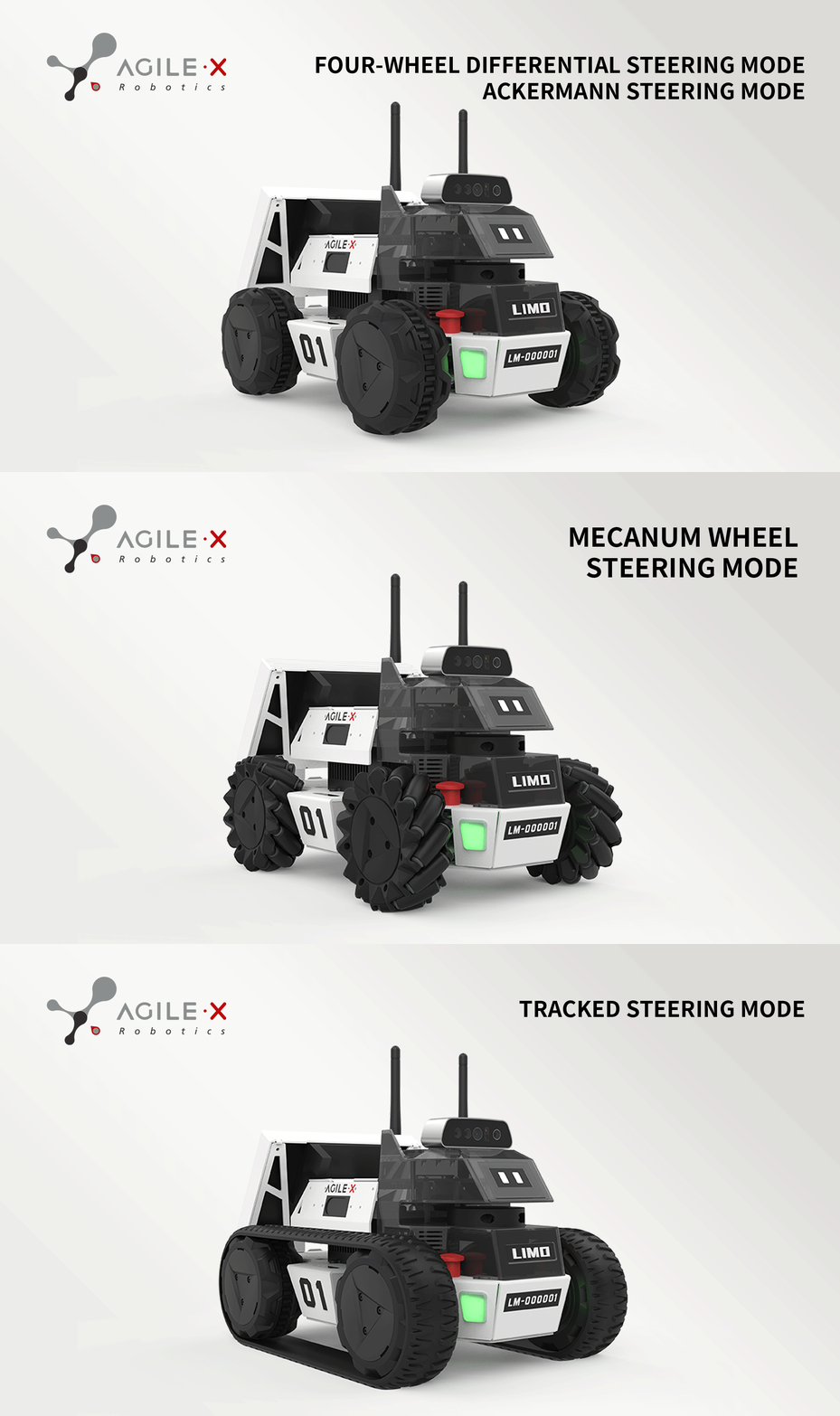


 Picture: Two Outdoor Delivery Robot Based on