

Mining, Energy & Utilities
Inspect remote infrastructure, critical equipment, pipelines, substations, and hazardous operating areas.
Automate routine inspection, monitoring, and data collection with autonomous mobile robots for demanding industrial environments.
Sensors, SLAM, planning, obstacle avoidance, and robot control require extensive integration.
Building an AMR from separate components and algorithms adds development risks and testing efforts.
Narrow aisles, repetitive structures, moving obstacles, and layout changes challenge reliable localization and navigation.
Maps, routes, tasks, robot status, and operational data are often managed across disconnected tools.
A complete robotic inspection system that combines autonomous mobility, navigation, multi-sensor data collection, and human-in-the-loop remote management.


Follows paths autonomously based on preset mission routes.

Collects equipment and ambient data in real time, streaming it to the control platform.

Automatically returns to the charging station to recharge and await the next mission.
Built for industries that require frequent, reliable inspection across hazardous, large-scale, remote, or operationally demanding environments.
Inspect remote infrastructure, critical equipment, pipelines, substations, and hazardous operating areas.
Automate routine equipment inspection, environmental monitoring, and safety patrols across factories and production sites.
Provide continuous patrol and monitoring across roads, warehouses, equipment zones, and distributed facilities.
Support autonomous security patrol and remote monitoring in office parks, shopping centers, and public venues.
From industrial facilities and mining sites to utilities and remote infrastructure, AgileX inspection solutions enable reliable autonomous patrol, monitoring, and data collection across demanding environments.

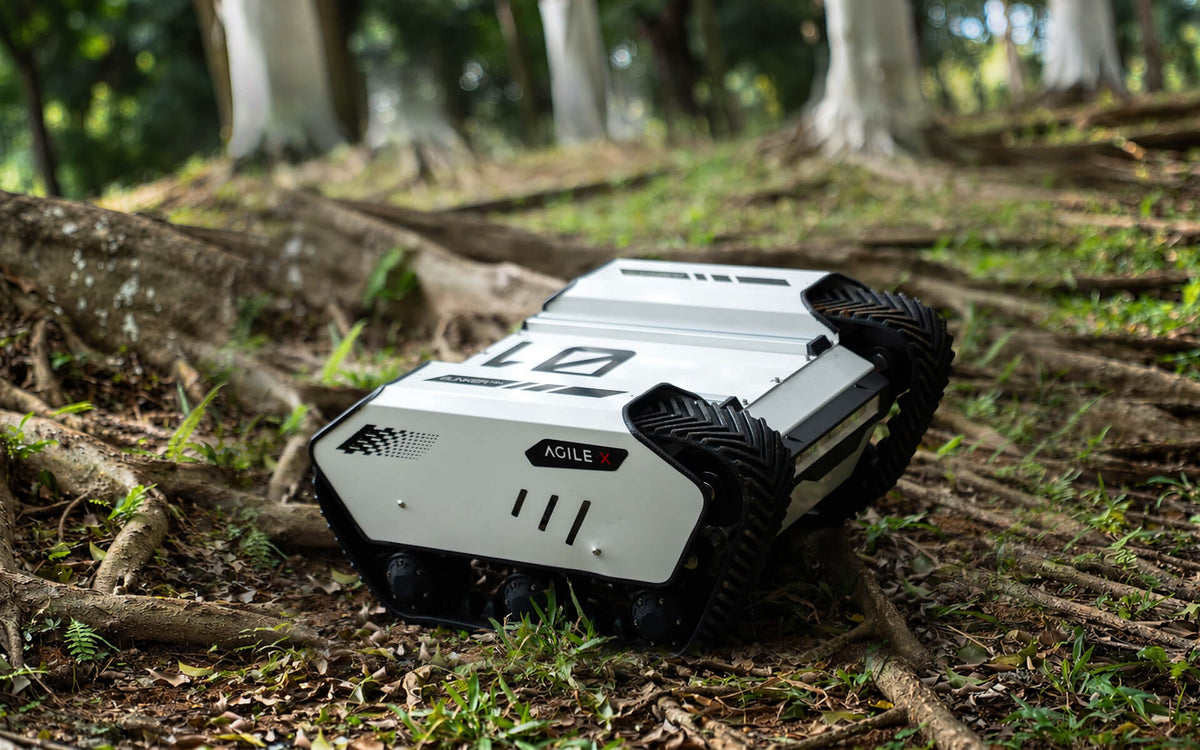
A large mining site in Australia deployed an inspection system built on the BUNKER PRO platform to autonomously collect critical infrastructure situations and environment data. The system lowers labor costs and minimizes personnel exposure to rugged and high-risk areas.

A water utility and pump station deployed a UMR-based inspection robot to perform scheduled patrols around pump equipment, pipelines, and electrical infrastructure. With integrated perception and autonomous navigation, the system captures routine inspection data, supports remote monitoring, and reduces the workload.

An outdoor inspection system built on BUNKER MINI and NAVIS supports emergency patrols across uneven terrain and changing weather conditions. By combining tracked mobility, autonomous navigation, and real-time environmental perception, it helps teams reach remote infrastructure quickly and assess on-site conditions.
Compact Tracked Mobile Robot
Learn More
Universal Mobile Robot
Learn More
Heavy-Duty Tracked UGV
Learn MoreAn industrial inspection robot is a mobile robotic system that autonomously travels through a site to collect visual, thermal, environmental, or equipment-condition data. It helps automate routine patrols, improve inspection consistency, and reduce personnel exposure to hazardous areas.
Yes. The robot platform can be selected according to terrain, route width, slope, payload, and weather exposure. Tracked and Ackermann-steering platforms are suitable for more demanding outdoor or uneven-site conditions.
Yes. With onboard sensors and autonomous navigation software, the robot can build or use digital maps, localize itself, follow planned routes, avoid obstacles, and execute scheduled inspection tasks with minimal intervention.
Typical configurations can include LiDAR, RGB or PTZ cameras, thermal cameras, depth cameras, GNSS/RTK, IMUs, gas sensors, and temperature-and-humidity sensors. The final configuration depends on the inspection target and site conditions.
Typical applications include mining, energy and utilities, oil and gas, manufacturing, warehousing, water and wastewater facilities, transportation infrastructure, and industrial campuses.
Yes. Robot platforms, sensors, routes, checkpoints, mission logic, and data outputs can be configured around existing inspection procedures, site maps, and operational requirements.
Connect with our robotics experts to discuss your needs and discover the perfect robotics platform for your business.
Your inquiry has been received. Our robotics engineers will get back to you as soon as possible.